

Prepay or Postpay? Choosing the Right Ordering Model for School Photography
Should families order school photographs before photo day, or wait until they have seen the images?
It sounds like a simple choice, but the answer affects almost every part of a school photography business - from parent communication and sales to editing, cash flow, printing and late-order fulfilment.
Reading Time: Approx 18 mins
Prepay or Postpay? Choosing the Right Ordering Model for School Photography
Should families order school photographs before photo day, or wait until they have seen the images?
It sounds like a simple choice, but the answer affects almost every part of a school photography business - from parent communication and sales to editing, cash flow, printing and late-order fulfilment.
Reading Time: Approx 18 mins
The traditional prepay school photography model asks families to select and pay for a package before the student is photographed. In a postpay model, students are photographed first, and families choose what they would like to purchase after viewing the images through an online gallery or, traditionally, as physical print proofs. Online postpay galleries are commonly used for Kinder (Kindy) photography, where a more varied and personalised selection of portraits may be offered.
Both models can work well. But there can be expensive inefficiencies when the ordering method does not fit the photographer’s products, technology, staffing or relationship with the school.
For most traditional school photography programs, however, prepay has an important advantage: the sale is made before the photographer does the majority of the processing, production and fulfilment workload (and before they incur costs).
So the right question is not simply “Which model sells more?” It is:
Which ordering model creates the best balance of family confidence, order conversion/participation and average order value – while ensuring the work required to produce the sale remains commercially sustainable?
What is a Prepay School Photography Model?
In a prepay model, families place and pay for their order before photo day or before seeing the finished portraits. The order may be made through a paper envelope, online store or a combination of both.
The photographer knows in advance which students have ordered, which packages they require and whether optional photographs, such as sibling portraits, have been booked.
Some photographers using prepay systems photograph every eligible student regardless of order status. Others use the order list to determine who is photographed or which additional poses and products are required.
Prepay has long suited school photography because it supports consolidated, streamlined production. Orders can close, files can be processed against known product requirements and one large batch can be printed, packed and delivered to the school. And so the production effort is spent on customers who have actually purchased.
What is a Postpay School Photography Model?
In a postpay model, students are photographed first. Families receive access to a gallery or proof afterwards, then choose their preferred images and products and place an order.
This allows parents to see expressions, poses and image quality before spending. It can also support a broader product range, multiple poses and personalised packages.
Postpay usually requires every student’s images to be matched, prepared, uploaded and presented securely, even when that family never orders. Production begins after orders arrive and may run across several batches or remain open for an extended period.
The model can feel more like contemporary portrait photography, but it transfers more work, cost and risk to the photographer before the sale is made. This is an important distinction when working at school scale.
Prepay: The Main Advantages
Prepay gives the photographer valuable certainty before production begins.
For schools with strong parent participation, prepay can be extremely efficient. For an independent photographer building a school photography business, that efficiency can also make the difference between a workflow that scales and one that becomes increasingly labour intensive as more schools are added.
Prepay: The Main Advantages
Prepay gives the photographer valuable certainty before production begins.
For schools with strong parent participation, prepay can be extremely efficient. For an independent photographer building a school photography business, that efficiency can also make the difference between a workflow that scales and one that becomes increasingly labour intensive as more schools are added.
Prepay: The Main Limitations
The main barrier is that families are being asked to buy an image they have not seen.
Parents may hesitate because they are unsure whether their child will smile, whether the pose will suit them or whether the photograph will feel worth the price. This can be particularly important for families who have had disappointing school photographs in the past.
However, this limitation can be actively managed. Traditional school photography is a familiar product: parents generally understand the type of photograph they are purchasing. Strong sample images, clear package descriptions and a simple remake or satisfaction policy can significantly reduce the uncertainty.
Prepay can also create:
- pressure to keep packages simple enough to choose without previews
- uncertainty about which pose or expression will be supplied
- reduced opportunity to sell additional images after parents see them, unless a follow-up sales opportunity is offered
- refund, remake or complaint handling when expectations are not met or if a paid student is absent
Importantly, most of these limitations can be reduced through good communication and a good shopping cart design.
Postpay: The Main Advantages
Postpay removes much of the uncertainty for families.
Postpay can suit photographers bringing a more personalised portrait style into the school market, especially when several genuinely different images are captured for each student. This is one reason it can work particularly well in Kinder photography and other portrait-led services.
Postpay: The Main Limitations
The photographer must complete more work before knowing whether they’ll make a sale. Every student’s photographs may need to be culled, matched, colour corrected, cropped, rendered, uploaded and checked. Private gallery access must be generated and communicated. Customer service then continues as families locate access details, reset passwords, ask product questions and place late orders.
Furthermore, modern AI tools can increasingly remove watermarks or improve low-resolution proof images, reducing some of the protection historically provided by watermarked online proofs.
Other challenges include:
- delayed cash flow
- the cost of processing images for non-buyers
- people stealing images (downloading images and removing watermarks)
- lower urgency when galleries remain open indefinitely
- orders arriving in many small batches
- repeated lab, packing and delivery work
- parents viewing galleries but postponing the decision
- managing image-selection and product-choice complexity
- keeping galleries and personal information secure
Postpay is not simply prepay with a gallery added. It is a different production and customer-service model, and much more of its cost is incurred before the customer commits.
Compare the True Cost of Each Model
Average order value is important, but it should not be assessed in isolation.
Compare:
- participation/conversion rate: how many photographed families order
- average order value
- total revenue per photographed student
- post-production work performed before purchase
- number of photographed students processed for each paying customer
- number of production batches
- packing and delivery costs
- payment and platform fees
- customer-service time
- pre-sale communication costs
- gallery hosting and maintenance
- refunds, reprints and remakes
- late-order administration
A postpay model may generate larger individual orders but fewer participating families. A prepay model may achieve broader participation with smaller, more predictable packages.
For that reason, average order value alone can be misleading. A $90 average order is not automatically better than a $60 average order if considerably fewer families purchase and substantially more work was required to generate each sale.
The useful measure is contribution after the work required to create and fulfil the revenue, not the headline value of a few large orders.
When the full workflow is considered, prepay often has an advantage because the sale, production requirement and customer commitment are established earlier.

The School Community Matters
Things to consider:
- price sensitivity
- the school’s preferred communication channels and the strength in communicating
- parent familiarity with online ordering
- access to reliable internet and digital payment methods
- language and accessibility needs
- expectations created by the previous photographer
- whether the school wants minimal administration
- the timing of other school expenses and events
Both models require schools to communicate well with families. However that becomes critical with a postpay as it doesn’t have the clear, hard cut off that the prepaid “photo day cut off” provides and the reminders to login and view proofs can get lost in the hundreds of other reminders parents see each week.
Importantly, do not confuse the preferences of one vocal parent or staff member with the behaviour of the whole community. Review actual order data after each event.
Product Range Should Influence the Decision
Simple, fixed packages are easier to sell before images are seen. A family can understand that a package contains one enlargement, several smaller prints and a class photograph without making many image-level decisions.
Postpay becomes more attractive when you offer:
- multiple poses or expressions
- build-your-own packages
- personalised gifts
- premium enlargements or wall products
However, more choice is not automatically better. A large gallery and complicated menu can overwhelm families and reduce completion. It can also lead to more customer service calls and emails.
For a traditional school photography offer, simplicity can be a strength. A clearly priced prepay package asks the parent to make one straightforward purchase decision. Additional choice can then be introduced later where it has a genuine opportunity to increase the sale.
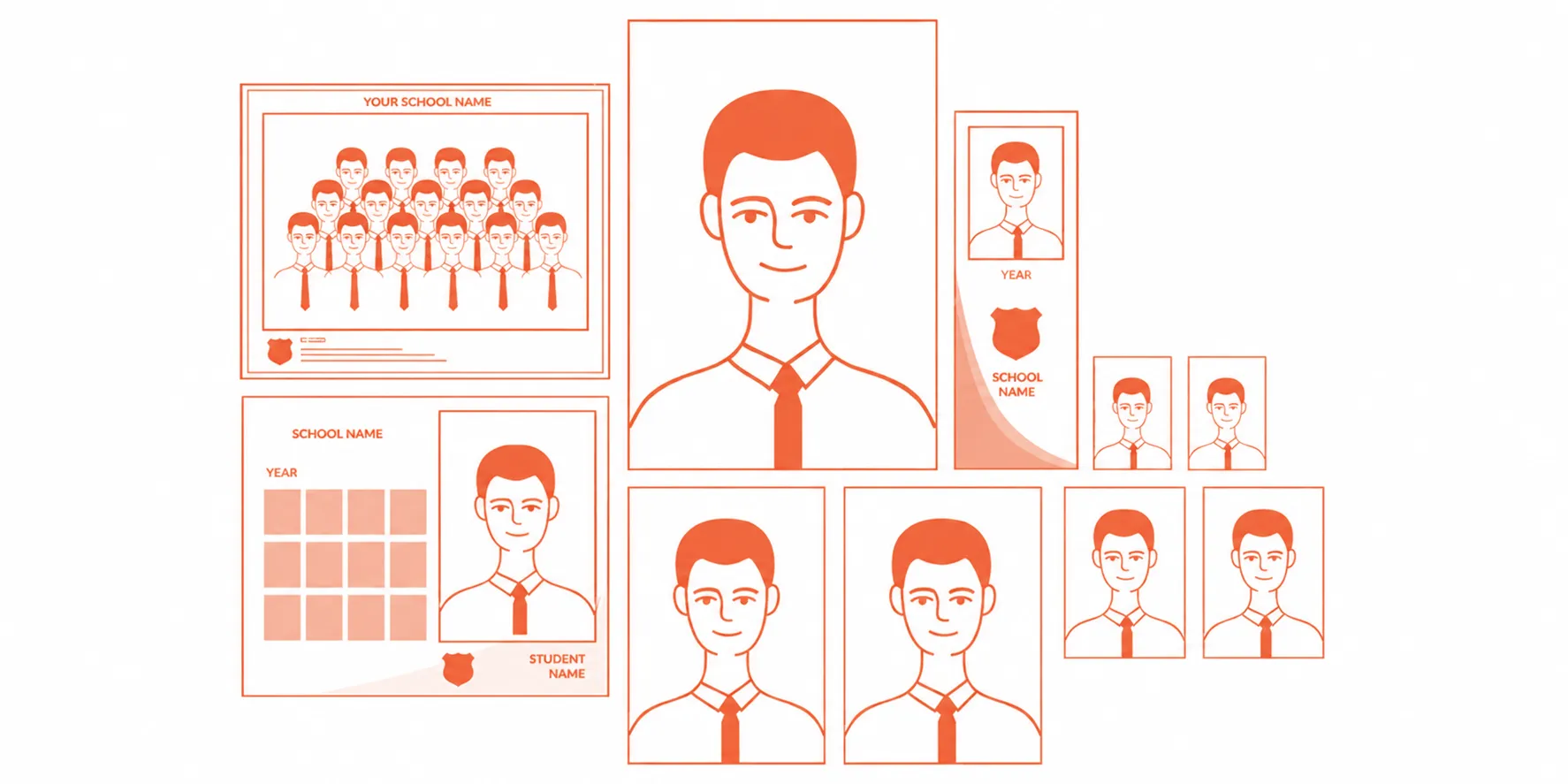
Photo-day Capture Changes with the Sales Model
Prepay often supports a highly standardised capture: one dependable master portrait, perhaps with a small number of variations/crops.
That standardisation is one of the strengths of high-volume school photography. The photographer can concentrate on creating a consistently good expression and pose rather than producing additional files simply to populate a gallery. It becomes faster, which means lower wages or less time from you and a happier school if the time out of class is reduced also.
Postpay usually benefits from enough genuine choice to justify viewing a gallery. If every image looks almost identical, families may question why they were asked to wait and select.
That does not mean capturing dozens of files per student. Every additional image creates matching, storage, culling and gallery work. Establish a deliberate pose and expression set that can be produced consistently within the timetable.
Confirm whether:
- every student receives the same number of images
- only ordered students receive additional poses
- families may select different images for different products
- every pose works in every crop and package opening (aspect ratio)
- sibling photographs follow the same ordering model
The promise made in the ordering system must match what the photography team can deliver on the day.
Matching and Identification Remain Essential
Neither model removes the need for accurate student-to-image matching.
In prepay, the photographer must connect each order to the correct student and image. In postpay, the photographer must create a secure gallery in which each family sees the correct photographs.
The postpay risk can be especially visible: a matching error may expose another student’s images to the wrong family. Strong unique IDs, controlled capture, reconciliation and gallery-access testing are non-negotiable.
There are many good software options available for either model, reach out of read some of our other articles on what your options are here.
Communication Determines Whether Families Act
The ordering model succeeds only if parents understand what to do and when to do it.
For prepay, communication should explain:
- photo-day date
- ordering deadline
- package contents and prices
- how the portrait will look
- sibling-booking requirements
- payment options
- absence, refund and remake process
For postpay, communication should explain:
- when galleries will be available
- how access details will be delivered
- how privacy is protected
- gallery-closing or delivery deadlines
- product and image-selection process
- expected production and delivery time
Plan multiple reminders with the school. One email or paper slip is rarely enough. Messages should be brief, recognisable and sent at useful decision points rather than crowded into one long announcement.
In prepay, these reminders do more than communicate logistics. They create a defined sales campaign leading towards photo day, giving families repeated opportunities and a clear reason to order.
Deadlines are Crucial
An order deadline is not only the point at which files can move into consolidated production. It is the main driver behind triggering parents to order.
Without a clear deadline, prepay and postpay orders may trickle in for months. Prepay families may also request exceptions after the main batch has been printed (but those exceptions can be separated into a defined late-order workflow rather than determining the timing of the main production run).
Successfully communicating deadlines can move push substantially more orders from the ‘late-order workflow’ to the main print run, which saves you time.
Set and communicate:
- main order deadline
- expected school-delivery date
- late-order availability (and any late-order fee or delivery difference)
- gallery archive or closure date where applicable
If you accept late orders, design a specific late-order workflow. Decide whether they are printed on scheduled batch dates, shipped directly to families or held until a minimum batch is reached.
Avoid promising the same school-delivery timing after the main cut-off; the school won’t like it, and you will regret it also.
Digital Files Need Explicit Rules
Digital products can simplify fulfilment, but they introduce their own ordering questions.
Decide whether digital files are:
- included in particular packages
- sold individually or as a complete set
- supplied in print-resolution or screen-resolution form
- released on a specific date
In prepay digitals are often best used as incentives to purchase higher packages. Most companies will limit a lower packages to print only, then prints with a low res digital file then prints with a high res digital file. Once families have the digital file they have numerous options to print it through with no guarantee that they will get the quality that you would provide.
Do not rely on manually emailing files there are many options available. Again, read our other blogs or reach out to Streets Imaging for ideas.
In prepay, define which image will be supplied if the family cannot preview and select it. In postpay, ensure the gallery clearly distinguishes the image preview from the purchased file and communicates what the customer receives.
Can You Offer Prepay and Postpay?
Some school photographers combine elements of prepay and postpay rather than choosing one exclusively.
A hybrid approach might offer:
- discounted core packages before photo day, followed by an opportunity to purchase additional images
- pre-booked sibling photographs with postpay image selection
- a prepay package that includes one portrait, with upgrades available after viewing
- prepay individual and class photographs with optional postpay extras
- a short early-order period followed by a gallery with standard or higher late-order pricing
A particularly attractive hybrid is prepay first, postpay upsell second. The photographer secures the core customer before photo day and fulfils the promised package efficiently. Additional poses, digital files, gifts or enlargements can then be offered afterwards.
In this model, the gallery is no longer responsible for creating the original sale. Its job is to increase the value of a sale that has already been secured.
Hybrid models can still become confusing if the stages, prices and entitlements are not clearly separated. Before launching a hybrid workflow, map how one family moves through registration, capture, gallery access, ordering, production and delivery. Test edge cases such as duplicate orders, upgrades, absences and sibling groups.
Prepay Works Best When...
Prepay is often a strong fit when:
- the school has an established, trusted annual photo program
- packages are simple and standardised
- the photographer needs consolidated production
- early cash flow is important
- gallery preparation for every student would be disproportionate
- the school actively supports reminders
- the photography style and product examples are consistent
- the business is designed around high participation and operational efficiency
- the photographer wants a workflow that can scale across multiple schools
It is less effective when families strongly expect to select their expression, the portrait style is unfamiliar or the products depend on image-specific choices. Even then, a prepaid core offer combined with a later selection or upsell can address some of these limitations.
Postpay Works Best When...
Postpay is often a strong fit when:
- the photographer captures meaningful image variety
- seeing the photographs is central to the sales proposition
- secure gallery technology is already part of the workflow
- the product range supports upgrades and additional purchases
- the business can carry pre-sale processing costs
- customer-service and reminder capacity are available
- production can accommodate several order batches
- the school community responds well to digital ordering
It is less effective when every gallery requires substantial manual preparation, families are difficult to reach after photo day, the underlying product is essentially one standard school portrait, or small late orders make fulfilment uneconomical.
Postpay should therefore be chosen because viewing and selecting images materially improves the product – not simply because galleries feel more modern.
Test the Model with Real Numbers
Before changing an established service, model the likely workload and run a controlled test.
Track:
- number of students photographed
- number and percentage of families ordering
- revenue per photographed student
- average order value
- time spent preparing galleries or prepay materials
- number of photographed students processed per paying customer
- customer enquiries by category
- number of production batches
- late orders and delivery costs
- refunds, remakes and corrections
- total labour through to final fulfilment
Compare schools of similar size and profile where possible. One unusually engaged or disengaged community can distort the result.
If testing postpay, do not judge it solely by the first few days of gallery sales or by average order value. Review the full campaign, participation rate, reminder pattern, processing performed for non-buyers and the production tail.
If testing prepay, examine participation, revenue per student, the efficiency of consolidated production and whether families who missed the deadline were offered a viable second opportunity.
Common Ordering-Model Mistakes
Photographers often run into trouble when they:
- choose postpay because galleries feel modern without pricing the extra work
- compare average order value without considering participation (number of orders) and labour
- offer too many products or combinations and decisions
- leave order deadlines open-ended
- prepare every image extensively before confirming there is demand
- capture multiple poses without a clear selection workflow
- rely on the school to communicate without supplying a reminder plan
- mix paper and online orders without combining order records into a single viewing platform
- accept late orders through informal emails and messages
- launch a hybrid model without testing upgrades, absences and duplicates
The ordering method must be designed as part of the full workflow, not attached after the photography and products have already been decided.
For Most School Photographers, Prepay is the Stronger Starting Point
Prepay prioritises certainty, consolidated production and early customer commitment. Postpay prioritises confidence and image choice.
For most photographers building a school photography business, prepay provides the stronger starting point. It secures the core sale before the majority of the production workload is incurred, creates a clear order deadline, makes demand easier to predict and allows the school to move through production as a consolidated job.
Postpay can be interesting where seeing and choosing between genuinely different photographs is central to the product. But it is possibly most useful as a way to sell more to an existing prepaid customer.
There is an important difference between using postpay to make the sale and using postpay to increase an already-secured sale.
For an independent school photographer, a powerful model is to secure the core order before photo day, deliver a consistently strong photograph, then give families the opportunity to purchase more if they like what they see.
This approach keeps the simplicity and operational efficiency that have made prepay successful in school photography while still taking advantage of modern online galleries where they add genuine value.
An ordering experience that feels simple to families is usually supported by careful work behind the scenes.
Streets Imaging works with school, sport and event photographers on the post-production, printing, packing and fulfilment systems that sit behind school photography services. Talk with our team before finalising your packages and order exports so your prepay workflow – and any post-photo-day upsell – can move cleanly from customer selection to finished delivery.
ON THIS PAGE
The traditional prepay school photography model asks families to select and pay for a package before the student is photographed. In a postpay model, students are photographed first, and families choose what they would like to purchase after viewing the images through an online gallery or, traditionally, as physical print proofs. Online postpay galleries are commonly used for Kinder (Kindy) photography, where a more varied and personalised selection of portraits may be offered.
Both models can work well. But there can be expensive inefficiencies when the ordering method does not fit the photographer’s products, technology, staffing or relationship with the school.
For most traditional school photography programs, however, prepay has an important advantage: the sale is made before the photographer does the majority of the processing, production and fulfilment workload (and before they incur costs).
So the right question is not simply “Which model sells more?” It is:
Which ordering model creates the best balance of family confidence, order conversion/participation and average order value – while ensuring the work required to produce the sale remains commercially sustainable?
What is a Prepay School Photography Model?
In a prepay model, families place and pay for their order before photo day or before seeing the finished portraits. The order may be made through a paper envelope, online store or a combination of both.
The photographer knows in advance which students have ordered, which packages they require and whether optional photographs, such as sibling portraits, have been booked.
Some photographers using prepay systems photograph every eligible student regardless of order status. Others use the order list to determine who is photographed or which additional poses and products are required.
Prepay has long suited school photography because it supports consolidated, streamlined production. Orders can close, files can be processed against known product requirements and one large batch can be printed, packed and delivered to the school. And so the production effort is spent on customers who have actually purchased.
What is a Postpay School Photography Model?
In a postpay model, students are photographed first. Families receive access to a gallery or proof afterwards, then choose their preferred images and products and place an order.
This allows parents to see expressions, poses and image quality before spending. It can also support a broader product range, multiple poses and personalised packages.
Postpay usually requires every student’s images to be matched, prepared, uploaded and presented securely, even when that family never orders. Production begins after orders arrive and may run across several batches or remain open for an extended period.
The model can feel more like contemporary portrait photography, but it transfers more work, cost and risk to the photographer before the sale is made. This is an important distinction when working at school scale.
Prepay: The Main Advantages
Prepay gives the photographer valuable certainty before production begins.
For schools with strong parent participation, prepay can be extremely efficient. For an independent photographer building a school photography business, that efficiency can also make the difference between a workflow that scales and one that becomes increasingly labour intensive as more schools are added.
Prepay: The Main Advantages
Prepay gives the photographer valuable certainty before production begins.
For schools with strong parent participation, prepay can be extremely efficient. For an independent photographer building a school photography business, that efficiency can also make the difference between a workflow that scales and one that becomes increasingly labour intensive as more schools are added.
Prepay: The Main Limitations
The main barrier is that families are being asked to buy an image they have not seen.
Parents may hesitate because they are unsure whether their child will smile, whether the pose will suit them or whether the photograph will feel worth the price. This can be particularly important for families who have had disappointing school photographs in the past.
However, this limitation can be actively managed. Traditional school photography is a familiar product: parents generally understand the type of photograph they are purchasing. Strong sample images, clear package descriptions and a simple remake or satisfaction policy can significantly reduce the uncertainty.
Prepay can also create:
- pressure to keep packages simple enough to choose without previews
- uncertainty about which pose or expression will be supplied
- reduced opportunity to sell additional images after parents see them, unless a follow-up sales opportunity is offered
- refund, remake or complaint handling when expectations are not met or if a paid student is absent
Importantly, most of these limitations can be reduced through good communication and a good shopping cart design.
Postpay: The Main Advantages
Postpay removes much of the uncertainty for families.
Postpay can suit photographers bringing a more personalised portrait style into the school market, especially when several genuinely different images are captured for each student. This is one reason it can work particularly well in Kinder photography and other portrait-led services.
Postpay: The Main Limitations
The photographer must complete more work before knowing whether they’ll make a sale. Every student’s photographs may need to be culled, matched, colour corrected, cropped, rendered, uploaded and checked. Private gallery access must be generated and communicated. Customer service then continues as families locate access details, reset passwords, ask product questions and place late orders.
Furthermore, modern AI tools can increasingly remove watermarks or improve low-resolution proof images, reducing some of the protection historically provided by watermarked online proofs.
Other challenges include:
- delayed cash flow
- the cost of processing images for non-buyers
- people stealing images (downloading images and removing watermarks)
- lower urgency when galleries remain open indefinitely
- orders arriving in many small batches
- repeated lab, packing and delivery work
- parents viewing galleries but postponing the decision
- managing image-selection and product-choice complexity
- keeping galleries and personal information secure
Postpay is not simply prepay with a gallery added. It is a different production and customer-service model, and much more of its cost is incurred before the customer commits.
Compare the True Cost of Each Model
Average order value is important, but it should not be assessed in isolation.
Compare:
- participation/conversion rate: how many photographed families order
- average order value
- total revenue per photographed student
- post-production work performed before purchase
- number of photographed students processed for each paying customer
- number of production batches
- packing and delivery costs
- payment and platform fees
- customer-service time
- pre-sale communication costs
- gallery hosting and maintenance
- refunds, reprints and remakes
- late-order administration
A postpay model may generate larger individual orders but fewer participating families. A prepay model may achieve broader participation with smaller, more predictable packages.
For that reason, average order value alone can be misleading. A $90 average order is not automatically better than a $60 average order if considerably fewer families purchase and substantially more work was required to generate each sale.
The useful measure is contribution after the work required to create and fulfil the revenue, not the headline value of a few large orders.
When the full workflow is considered, prepay often has an advantage because the sale, production requirement and customer commitment are established earlier.
The School Community Matters
Things to consider:
- price sensitivity
- the school’s preferred communication channels and the strength in communicating
- parent familiarity with online ordering
- access to reliable internet and digital payment methods
- language and accessibility needs
- expectations created by the previous photographer
- whether the school wants minimal administration
- the timing of other school expenses and events
Both models require schools to communicate well with families. However that becomes critical with a postpay as it doesn’t have the clear, hard cut off that the prepaid “photo day cut off” provides and the reminders to login and view proofs can get lost in the hundreds of other reminders parents see each week.
Importantly, do not confuse the preferences of one vocal parent or staff member with the behaviour of the whole community. Review actual order data after each event.
Product Range Should Influence the Decision
Simple, fixed packages are easier to sell before images are seen. A family can understand that a package contains one enlargement, several smaller prints and a class photograph without making many image-level decisions.
Postpay becomes more attractive when you offer:
- multiple poses or expressions
- build-your-own packages
- personalised gifts
- premium enlargements or wall products
However, more choice is not automatically better. A large gallery and complicated menu can overwhelm families and reduce completion. It can also lead to more customer service calls and emails.
For a traditional school photography offer, simplicity can be a strength. A clearly priced prepay package asks the parent to make one straightforward purchase decision. Additional choice can then be introduced later where it has a genuine opportunity to increase the sale.
Photo-day Capture Changes with the Sales Model
Prepay often supports a highly standardised capture: one dependable master portrait, perhaps with a small number of variations/crops.
That standardisation is one of the strengths of high-volume school photography. The photographer can concentrate on creating a consistently good expression and pose rather than producing additional files simply to populate a gallery. It becomes faster, which means lower wages or less time from you and a happier school if the time out of class is reduced also.
Postpay usually benefits from enough genuine choice to justify viewing a gallery. If every image looks almost identical, families may question why they were asked to wait and select.
That does not mean capturing dozens of files per student. Every additional image creates matching, storage, culling and gallery work. Establish a deliberate pose and expression set that can be produced consistently within the timetable.
Confirm whether:
- every student receives the same number of images
- only ordered students receive additional poses
- families may select different images for different products
- every pose works in every crop and package opening (aspect ratio)
- sibling photographs follow the same ordering model
The promise made in the ordering system must match what the photography team can deliver on the day.
Matching and Identification Remain Essential
Neither model removes the need for accurate student-to-image matching.
In prepay, the photographer must connect each order to the correct student and image. In postpay, the photographer must create a secure gallery in which each family sees the correct photographs.
The postpay risk can be especially visible: a matching error may expose another student’s images to the wrong family. Strong unique IDs, controlled capture, reconciliation and gallery-access testing are non-negotiable.
There are many good software options available for either model, reach out of read some of our other articles on what your options are here.
Communication Determines Whether Families Act
The ordering model succeeds only if parents understand what to do and when to do it.
For prepay, communication should explain:
- photo-day date
- ordering deadline
- package contents and prices
- how the portrait will look
- sibling-booking requirements
- payment options
- absence, refund and remake process
For postpay, communication should explain:
- when galleries will be available
- how access details will be delivered
- how privacy is protected
- gallery-closing or delivery deadlines
- product and image-selection process
- expected production and delivery time
Plan multiple reminders with the school. One email or paper slip is rarely enough. Messages should be brief, recognisable and sent at useful decision points rather than crowded into one long announcement.
In prepay, these reminders do more than communicate logistics. They create a defined sales campaign leading towards photo day, giving families repeated opportunities and a clear reason to order.
Deadlines are Crucial
An order deadline is not only the point at which files can move into consolidated production. It is the main driver behind triggering parents to order.
Without a clear deadline, prepay and postpay orders may trickle in for months. Prepay families may also request exceptions after the main batch has been printed (but those exceptions can be separated into a defined late-order workflow rather than determining the timing of the main production run).
Successfully communicating deadlines can move push substantially more orders from the ‘late-order workflow’ to the main print run, which saves you time.
Set and communicate:
- main order deadline
- expected school-delivery date
- late-order availability (and any late-order fee or delivery difference)
- gallery archive or closure date where applicable
If you accept late orders, design a specific late-order workflow. Decide whether they are printed on scheduled batch dates, shipped directly to families or held until a minimum batch is reached.
Avoid promising the same school-delivery timing after the main cut-off; the school won’t like it, and you will regret it also.
Digital Files Need Explicit Rules
Digital products can simplify fulfilment, but they introduce their own ordering questions.
Decide whether digital files are:
- included in particular packages
- sold individually or as a complete set
- supplied in print-resolution or screen-resolution form
- released on a specific date
In prepay digitals are often best used as incentives to purchase higher packages. Most companies will limit a lower packages to print only, then prints with a low res digital file then prints with a high res digital file. Once families have the digital file they have numerous options to print it through with no guarantee that they will get the quality that you would provide.
Do not rely on manually emailing files there are many options available. Again, read our other blogs or reach out to Streets Imaging for ideas.
In prepay, define which image will be supplied if the family cannot preview and select it. In postpay, ensure the gallery clearly distinguishes the image preview from the purchased file and communicates what the customer receives.
Can You Offer Prepay and Postpay?
Some school photographers combine elements of prepay and postpay rather than choosing one exclusively.
A hybrid approach might offer:
- discounted core packages before photo day, followed by an opportunity to purchase additional images
- pre-booked sibling photographs with postpay image selection
- a prepay package that includes one portrait, with upgrades available after viewing
- prepay individual and class photographs with optional postpay extras
- a short early-order period followed by a gallery with standard or higher late-order pricing
A particularly attractive hybrid is prepay first, postpay upsell second. The photographer secures the core customer before photo day and fulfils the promised package efficiently. Additional poses, digital files, gifts or enlargements can then be offered afterwards.
In this model, the gallery is no longer responsible for creating the original sale. Its job is to increase the value of a sale that has already been secured.
Hybrid models can still become confusing if the stages, prices and entitlements are not clearly separated. Before launching a hybrid workflow, map how one family moves through registration, capture, gallery access, ordering, production and delivery. Test edge cases such as duplicate orders, upgrades, absences and sibling groups.
Prepay Works Best When...
Prepay is often a strong fit when:
- the school has an established, trusted annual photo program
- packages are simple and standardised
- the photographer needs consolidated production
- early cash flow is important
- gallery preparation for every student would be disproportionate
- the school actively supports reminders
- the photography style and product examples are consistent
- the business is designed around high participation and operational efficiency
- the photographer wants a workflow that can scale across multiple schools
It is less effective when families strongly expect to select their expression, the portrait style is unfamiliar or the products depend on image-specific choices. Even then, a prepaid core offer combined with a later selection or upsell can address some of these limitations.
Postpay Works Best When...
Postpay is often a strong fit when:
- the photographer captures meaningful image variety
- seeing the photographs is central to the sales proposition
- secure gallery technology is already part of the workflow
- the product range supports upgrades and additional purchases
- the business can carry pre-sale processing costs
- customer-service and reminder capacity are available
- production can accommodate several order batches
- the school community responds well to digital ordering
It is less effective when every gallery requires substantial manual preparation, families are difficult to reach after photo day, the underlying product is essentially one standard school portrait, or small late orders make fulfilment uneconomical.
Postpay should therefore be chosen because viewing and selecting images materially improves the product – not simply because galleries feel more modern.
Test the Model with Real Numbers
Before changing an established service, model the likely workload and run a controlled test.
Track:
- number of students photographed
- number and percentage of families ordering
- revenue per photographed student
- average order value
- time spent preparing galleries or prepay materials
- number of photographed students processed per paying customer
- customer enquiries by category
- number of production batches
- late orders and delivery costs
- refunds, remakes and corrections
- total labour through to final fulfilment
Compare schools of similar size and profile where possible. One unusually engaged or disengaged community can distort the result.
If testing postpay, do not judge it solely by the first few days of gallery sales or by average order value. Review the full campaign, participation rate, reminder pattern, processing performed for non-buyers and the production tail.
If testing prepay, examine participation, revenue per student, the efficiency of consolidated production and whether families who missed the deadline were offered a viable second opportunity.
Common Ordering-Model Mistakes
Photographers often run into trouble when they:
- choose postpay because galleries feel modern without pricing the extra work
- compare average order value without considering participation (number of orders) and labour
- offer too many products or combinations and decisions
- leave order deadlines open-ended
- prepare every image extensively before confirming there is demand
- capture multiple poses without a clear selection workflow
- rely on the school to communicate without supplying a reminder plan
- mix paper and online orders without combining order records into a single viewing platform
- accept late orders through informal emails and messages
- launch a hybrid model without testing upgrades, absences and duplicates
The ordering method must be designed as part of the full workflow, not attached after the photography and products have already been decided.
For Most School Photographers, Prepay is the Stronger Starting Point
Prepay prioritises certainty, consolidated production and early customer commitment. Postpay prioritises confidence and image choice.
For most photographers building a school photography business, prepay provides the stronger starting point. It secures the core sale before the majority of the production workload is incurred, creates a clear order deadline, makes demand easier to predict and allows the school to move through production as a consolidated job.
Postpay can be interesting where seeing and choosing between genuinely different photographs is central to the product. But it is possibly most useful as a way to sell more to an existing prepaid customer.
There is an important difference between using postpay to make the sale and using postpay to increase an already-secured sale.
For an independent school photographer, a powerful model is to secure the core order before photo day, deliver a consistently strong photograph, then give families the opportunity to purchase more if they like what they see.
This approach keeps the simplicity and operational efficiency that have made prepay successful in school photography while still taking advantage of modern online galleries where they add genuine value.
An ordering experience that feels simple to families is usually supported by careful work behind the scenes.
Streets Imaging works with school, sport and event photographers on the post-production, printing, packing and fulfilment systems that sit behind school photography services. Talk with our team before finalising your packages and order exports so your prepay workflow – and any post-photo-day upsell – can move cleanly from customer selection to finished delivery.